

Building Capabilities: Thinking about tasks, constraints and capacities.
This blog is part of our evolving thinking behind our new course: Movements for Life.
To develop course we’ll usually start with a big research phase to understand what the science says, and then look more closely at what might be missing from that - where the gaps are between research and real-world application. From there, we speak to a range of experts — typically researchers, coaches, physios, and doctors — to understand what’s currently being done in practice and where there might be overlap or blind spots.
We also try to look more broadly across different fields — what’s being discussed elsewhere that hasn’t yet filtered into physical activity or exercise. For example, in this current course we’ve been drawn to a lot of the capabilities work that comes out of the WHO’s International Classification of Functioning, Disability and Health (ICF), which is a framework used to understand health and disability at both individual and population levels.
We then take these ideas into our in-person groups and start testing them. We’re lucky to work with quite a diverse membership, so we can explore things with people who are more physically confident, and then also trial elements within sessions that include older adults and people with a wide range of abilities. A lot of our learning comes from these sessions and the feedback that follows and the creative workarounds that come up in class.
Finally, when we run a course online for the first time, we offer it at a reduced rate and treat that as a learning phase. We learn a huge amount from that first cohort, and those early participants are invited back onto the next version of the course, as it’s almost always improved the second time round.
This blog is a summary of where we are in terms of mapping out Movements for Life. Do leave comments at the end, we’d love to hear from you.
Mapping what is out there
As we’ve been developing the new course, Capabilities for Life, we realised it’s a good opportunity to rethink some of our initial assumptions - about how we make sense of everything we do at WildStrong.
Since Andew’s background was in strength and conditioning before he studied public health, we’ve realised that a lot of our early frameworks were limited by exercise and fitness models. Much of our learning journey in developing Wildstrong has been learning to forget some of early ideas as we learn more about people, communities and building capabilities.
One of our first questions that emerged during one of our planning sessions, is how do we make sense of all this? - What should we focus on and how do we design a course to help expand capabilities and opportunities to engage with the world around us?
How do we map out human capabilities?
Where do we begin when we try to think about what tasks humans are able to do?
How do we categorise them?
Do we make a big list/taxonomy?
Can we apply broad theories that have explanatory power?
How do we account for different contexts, goals and abilities?
One of the first issues Andrew focused on was how do we make sense of human abilities?
Who else has tried to map out all the different and amazing things we can do?
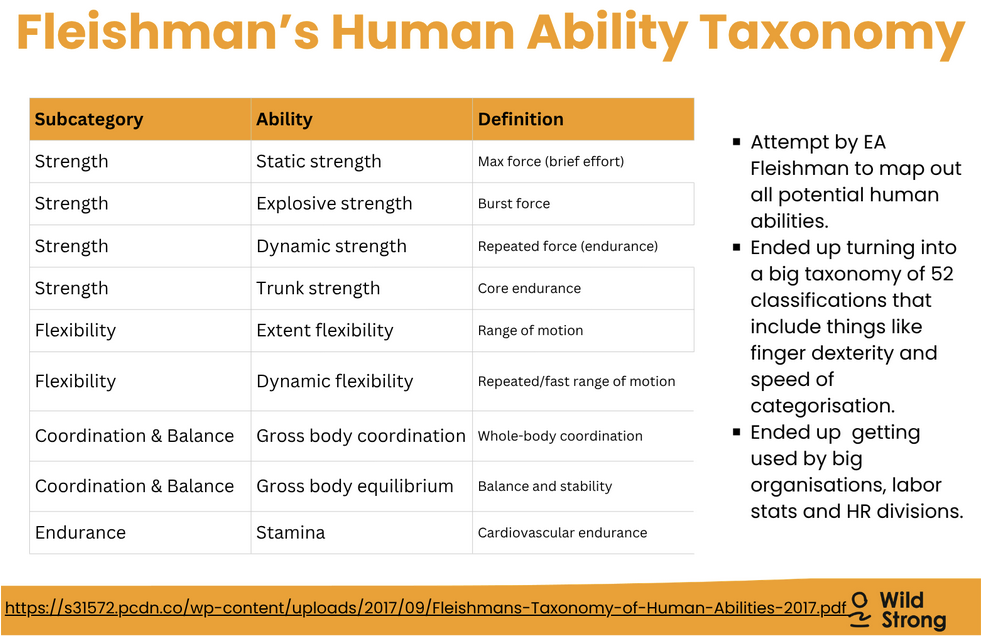
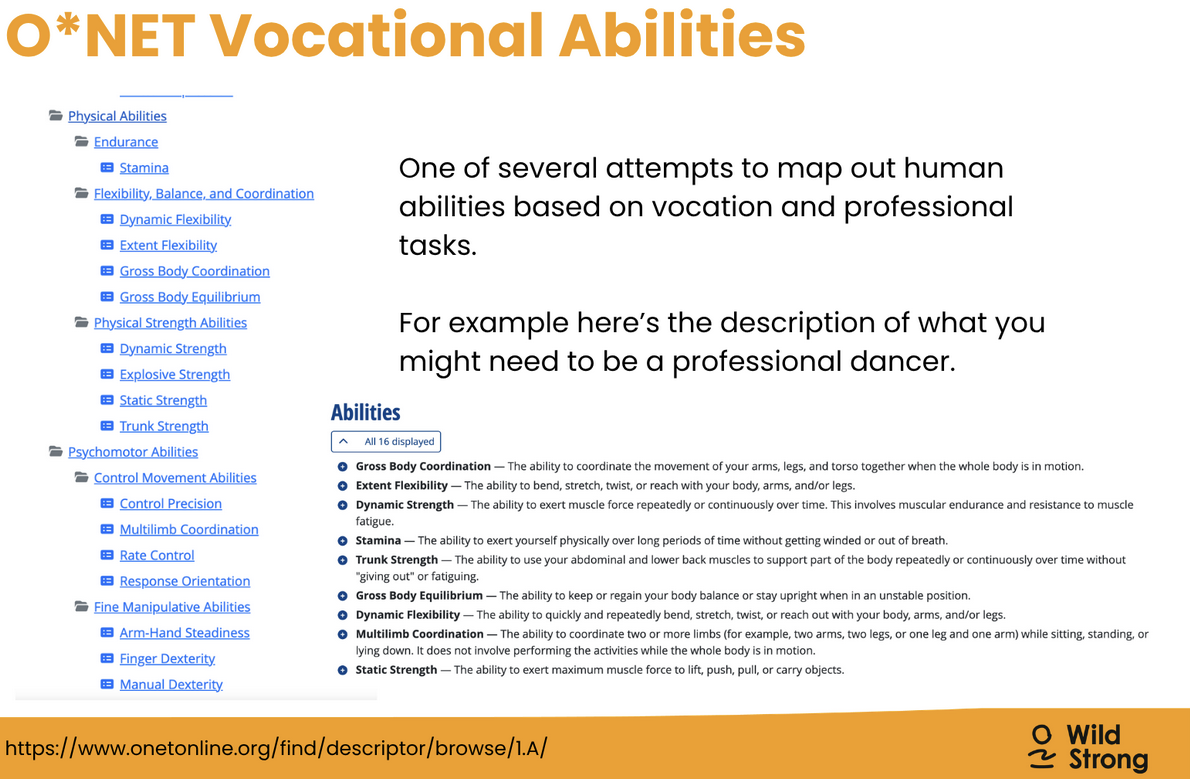
In the post war era there were all sorts of organisation attempts to create taxonomies of human abilities. EA Fleishman derived a framework with 52 abilities which has been adopted by labor statistics organisations as an attempt to operationalise human abilities through the lens of of vocations.
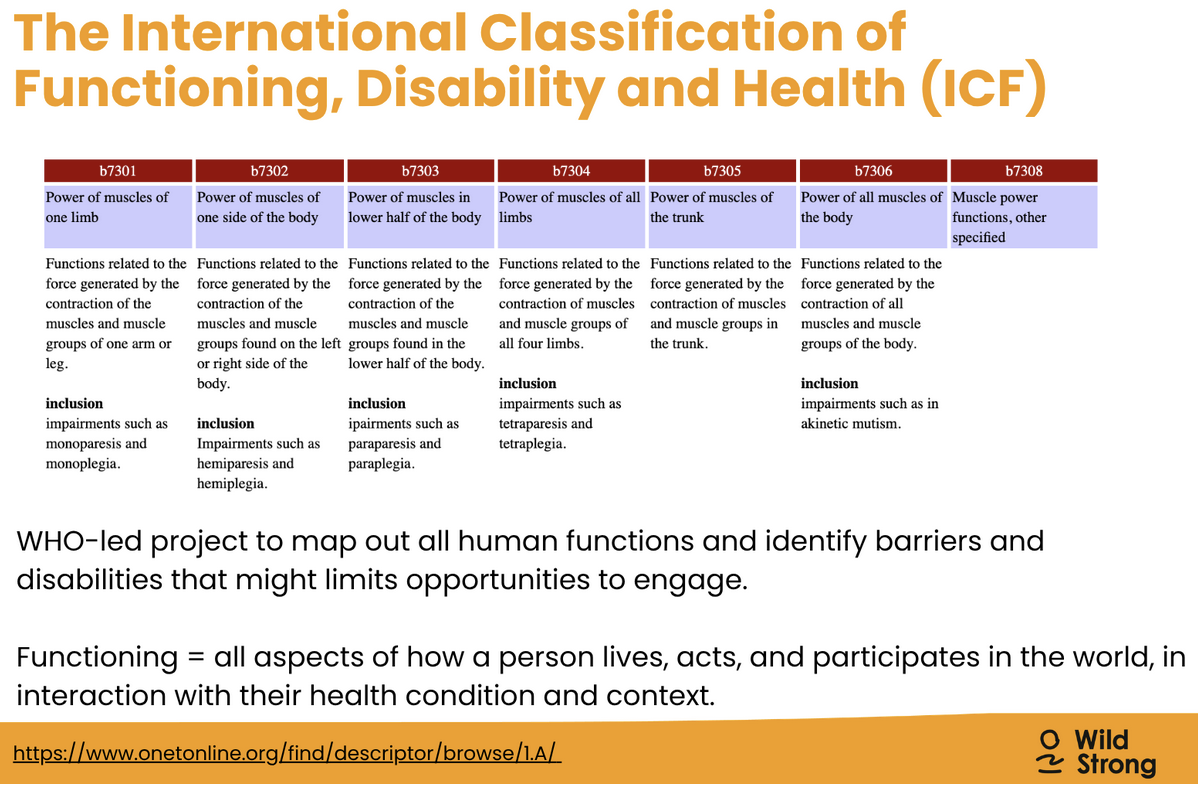
In the early 2000s, the WHO, inspired by Nussbaum's and Sen’s Capability Approach created the ICF model which situated human functionings in the context of their environment and reframed the way we look at disability. This model has also been adopted by occupational therapists.
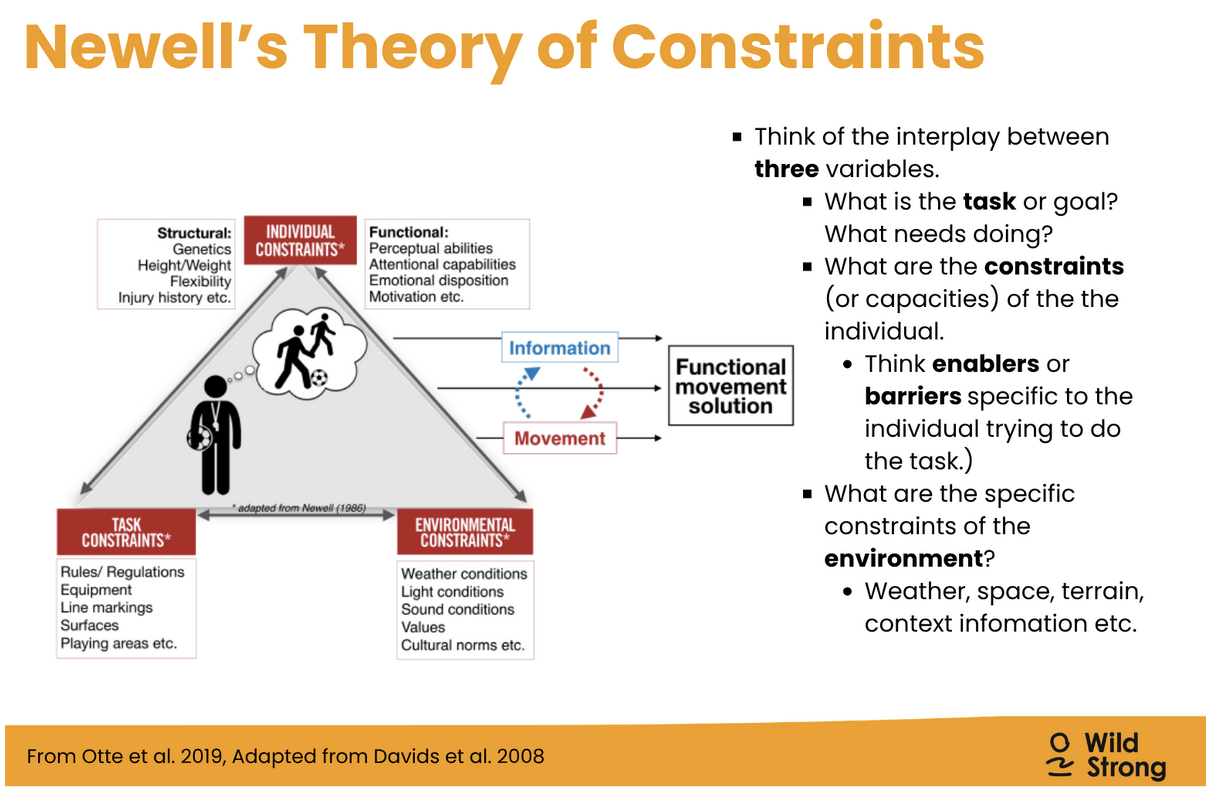
Meanwhile psychologists and skill development experts were working on a synthesis of Gibson’s Ecological Psychology and other models like Newell’s Dynamical Systems Theories to create current ecological dynamic models.
These models looked at ability through the relationship between tasks, environmental constraints and individual constraints. This obviated the need to create giant taxonomies or ability trees.
When we started developing Nature Moves, we began to incorporate more ecological design principles, especially task design and emergent coaching principles. We found that a lot of the prescriptive assumptions in the fitness industry weren’t very useful outside of gyms and that the prescriptive style of coaching was usually inappropriate for older adults trying to maintain and build real-life capabilities.
We started using a basic task-based model.
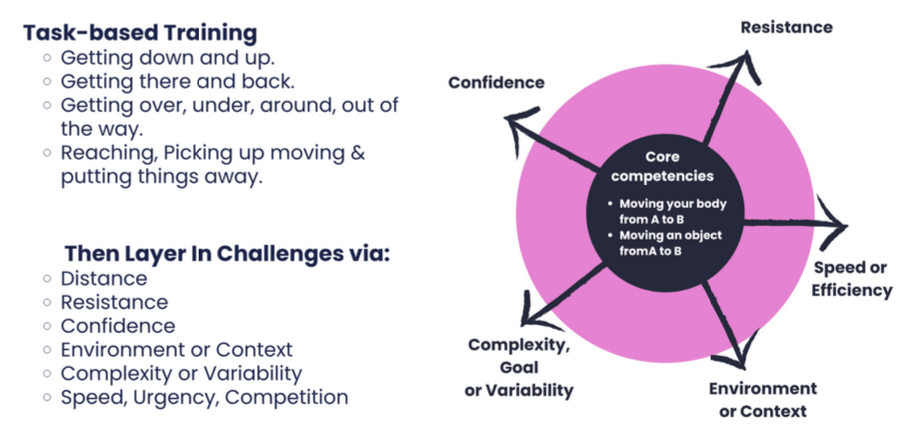
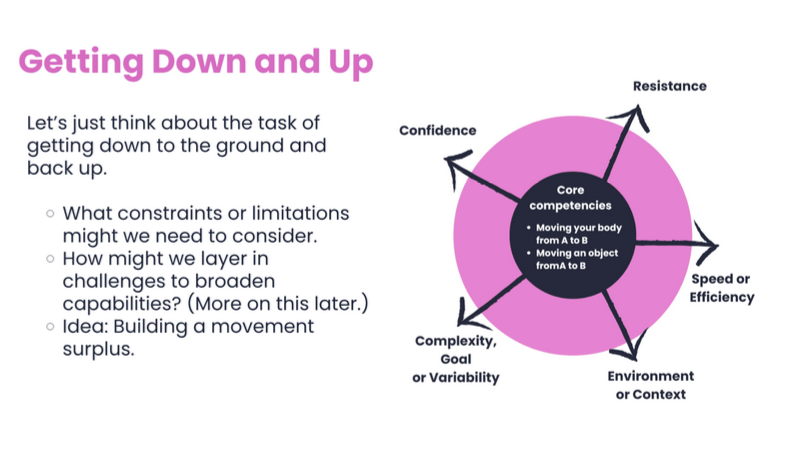
As we tried to map out the course, we realised that we needed to expand on our early task-based model and we started to create a 3 layered framework of task families, environmental constraints, and individual capacities. While this is largely based on Newell’s model, we needed to create a framework that was useful for practitioners to quickly design and evaluate task-based training programmes.
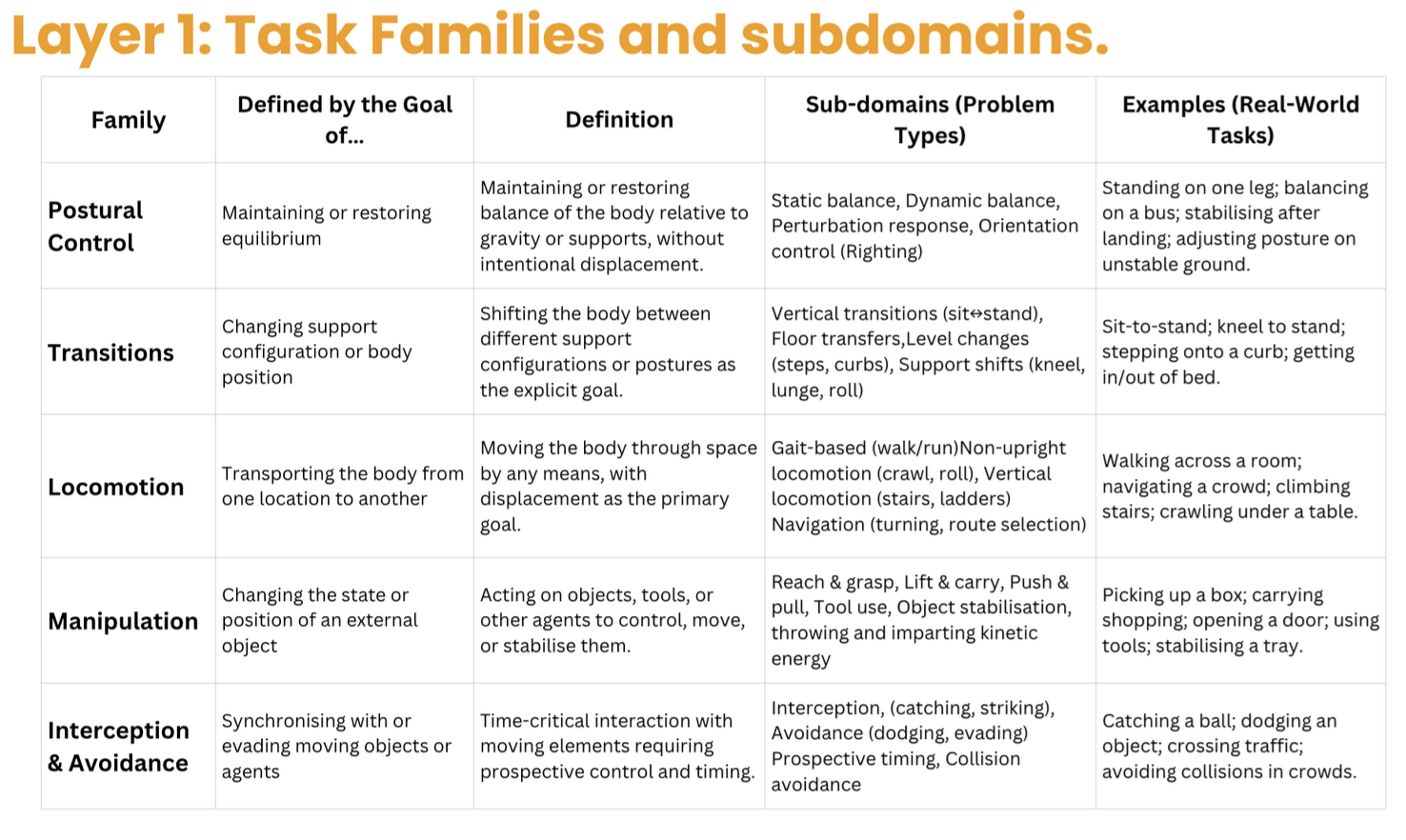
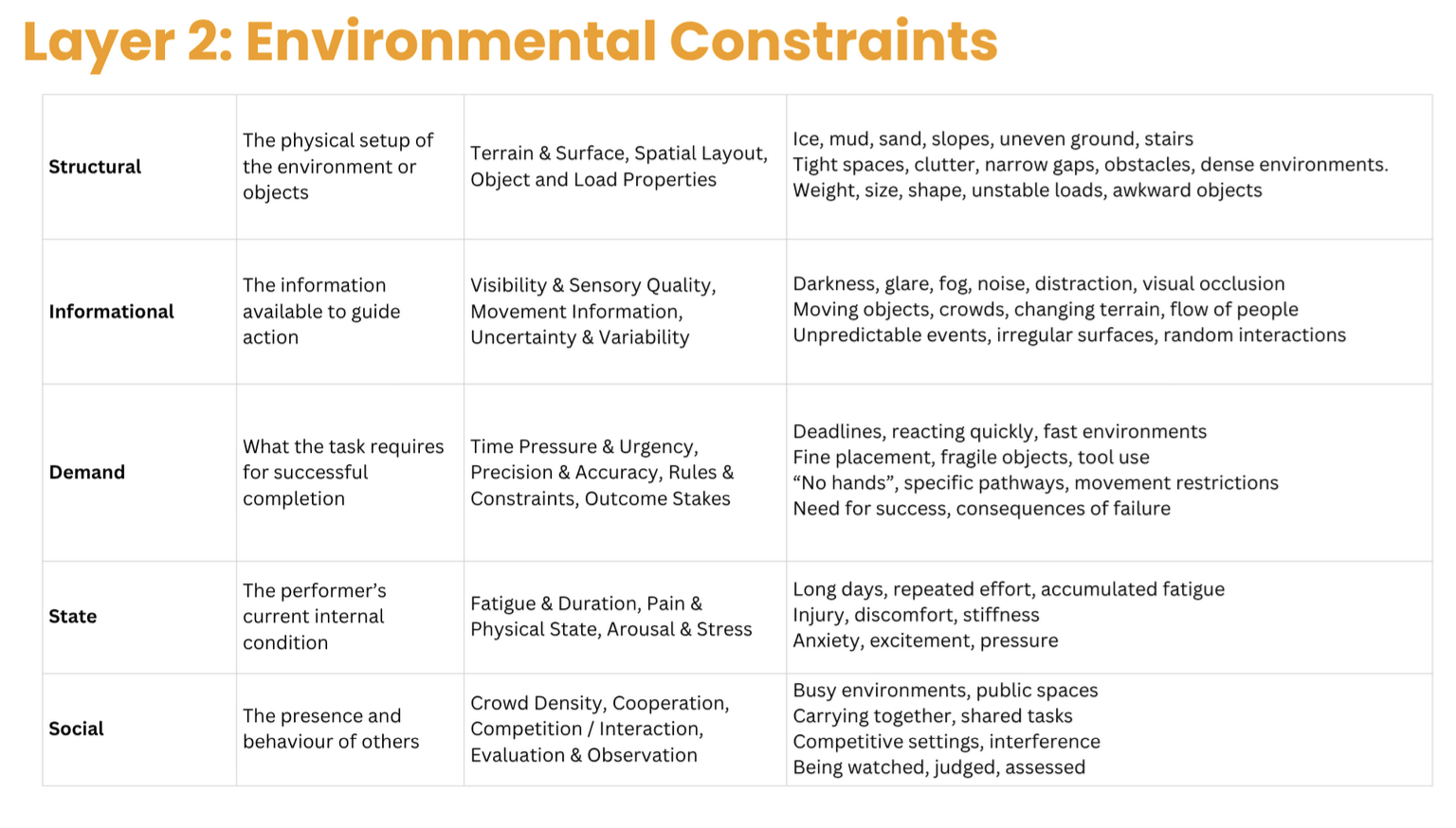
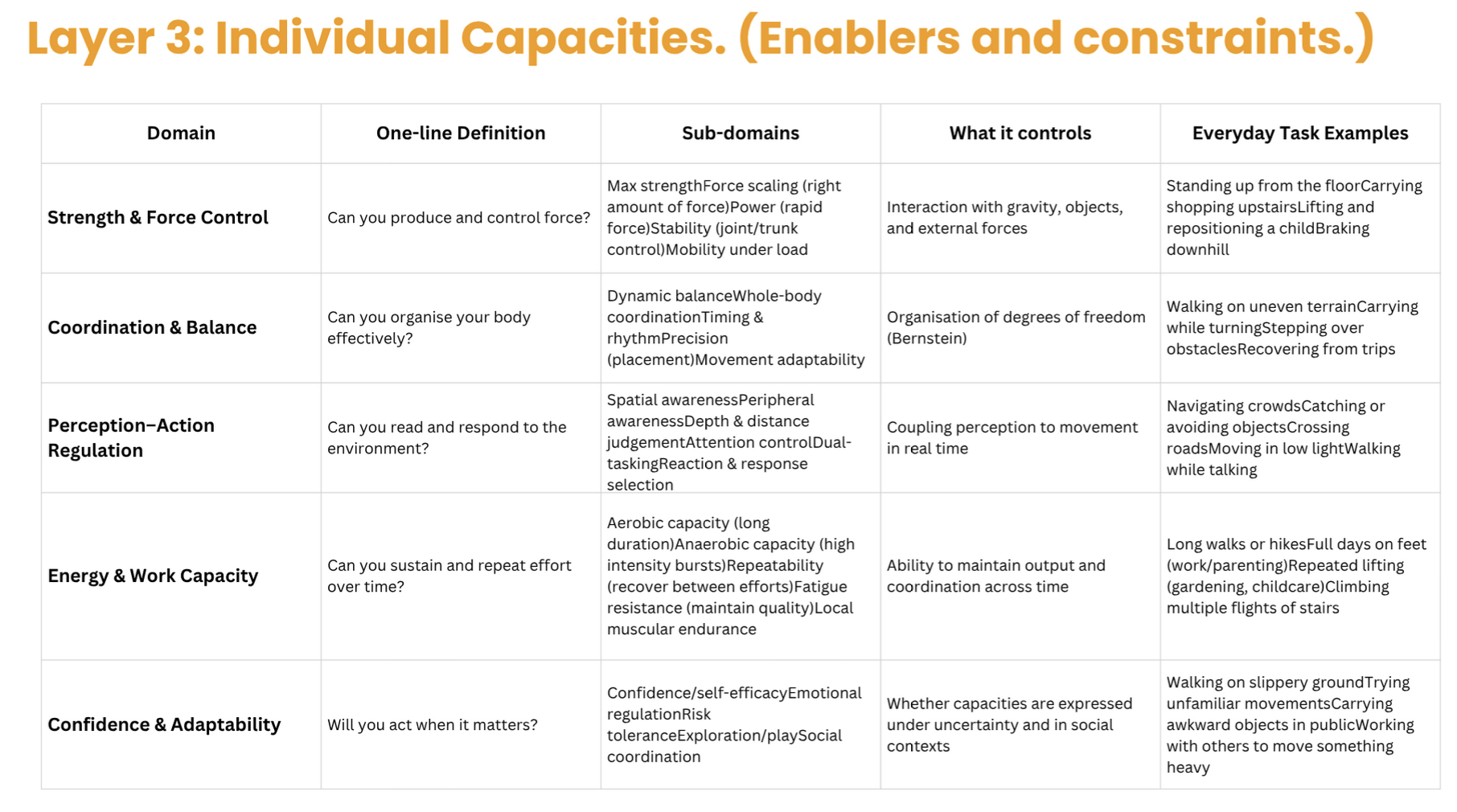
There isn’t a neat or complete way to map human capability as the more we try to fix it into categories, the more we risk losing the thing we’re trying to build - adaptable, confident people who can respond to the demands of real life.
What’s felt more useful is moving the question from “what’s the right exercise?” to which tasks matter to this person, in this environment, right now - and what capacities might help expand their options?
The framework we’re building around tasks, constraints and capacities will be a tool you can use. One that helps you notice more, experiment more, and gradually widen what’s possible in the world around you.
More to come as we build this. Thanks for reading.
