“All models are wrong, but some are useful”
The question at heart of everything we do is: ‘how can you keep doing all the things you love, with the people you love, in the places you love?’
I mean, there’s loads of questions, but this is probably the sentiment in the middle of it all.
When we first started building WildStrong, much of our thinking still sat inside fairly traditional fitness and strength models. Andrew’s background was originally in strength and conditioning before moving into public health, and many of our early frameworks reflected that.
Like a lot of people in fitness, we started by thinking largely through the lens of exercises, programmes and measurable outcomes. What movements should we be doing? We initially looked at lots of models (there are many, many models) and we originally came up with with this:
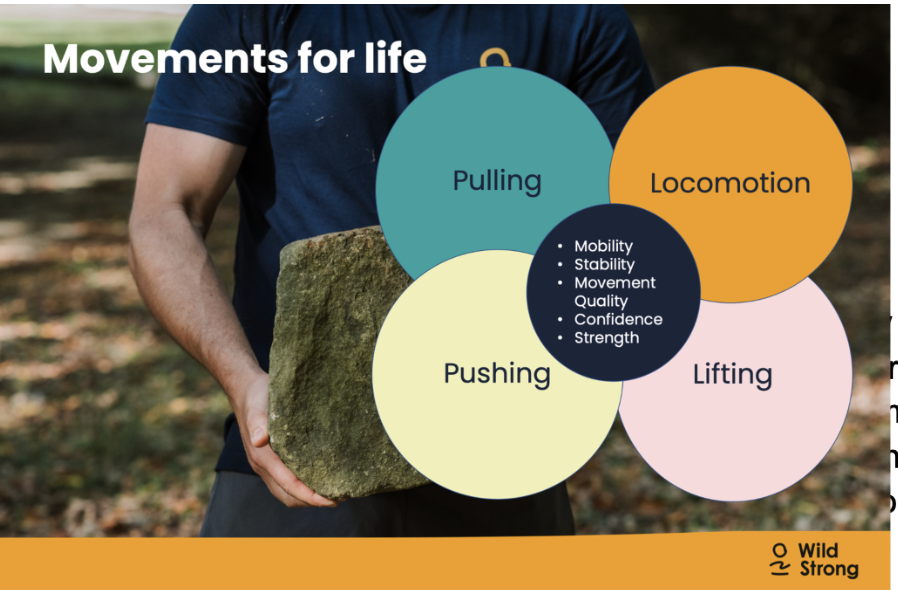
Probably most closely aligned with Dan John’s but inspired by Ian King and Paul Chek. All of these movement patterns are useful but over time we started running into the edges of those models, particularly when working with older adults, cautious movers and community groups. Complex spaces where life kept presenting problems that didn’t fit neatly inside gym-based exercise categories. This mode proved to quite limited and constrained our own ideas about what was possible.
Someone could become physically stronger while simultaneously becoming less adaptable, less able to explore and less connected to the environments around them. There were so many movements and activities that fell outside the confines of the model.
And some of the qualities that seemed to matter most in everyday life became increasingly difficult to measure cleanly:
Confidence.
Adaptability.
Environmental awareness.
Reaction.
Coordination.
The ability to solve movement problems in real time.
The social confidence to participate.
Permission to let oneself try
The more we explored this, the more we found ourselves drifting into other fields looking for better ways to think about human capability. How do you even map human capability?
Do you create giant taxonomies of movement skills?
Do you categorise every human action?
Do you build endless trees of abilities and sub-abilities?
The deeper we went into this, the more slippery it became.
When we created the video resources for coaches on our in-person course - over 100 hours of sequential coaching skills - we created a massive mind-map. It’s pretty ugly, but it shows our thinking at the time and we wanted to start categorising movements.
But every time we try, we come back to the elephant in the room - the moment you start trying to fully categorise human movement, you risk losing the thing you’re actually trying to build.
The quote from George Box springs to mind here: “All models are wrong, but some are useful.”
One of the ideas that became increasingly useful to us came through ecological dynamics and Newell’s constraints model. Rather than seeing movement as isolated exercises to perfect, it instead looked at the relationship between the individual, the task and the environment.
That ended up changing quite a lot for us as instead of asking, “What’s the right exercise?”
We started asking:
“What is this person trying to do?”
“What environment are they doing it in?”
“What capacities might help expand their options?”
Once you stop focusing on the movement and start focusing on the task and the multitude of options you have available to you to solve it, it really helps shift your understanding of what you are capable of right now and what you might be capable of with time, practice and support.
One of the examples we use often in our courses is to imagine picking up a sleeping child without waking them. Nobody needs a lecture on “proper deadlift form,” people instinctively slow down, adjust their position, shift their weight carefully, and move with attention. The task itself organised the movement. So many of these qualities are difficult to quantify cleanly inside conventional fitness culture. You can’t easily put “moving carefully in an emotionally meaningful situation” into a spreadsheet. And yet these movements are no less useful than you goblet squatting 32 kg.
There’s a Kurt Vonnegut story Andrew mentioned during the webinar that we’ve kept coming back to. Vonnegut’s wife suggests he should simply buy a thousand envelopes at once instead of going to the shop every time he needs one as it would be more efficient. But he prefers buying one at a time because in the process of going shopping he sees people, notices things, has conversations and becomes part of the world for a while. The envelope isn’t really the point.
That idea feels increasingly relevant to movement. Sometimes in trying to optimise movement, we accidentally strip away the wider experience surrounding it, the small acts of adaptation and decision making.
Capability is never just physical capacity in isolation; confidence, social support, environment and opportunity all play a part.
If someone becomes less confident, they often start withdrawing from movement-rich environments. Their world slowly narrows, they stop encountering variability, uncertainty and challenge, which then further reduces confidence. The same can be applied to pain avoidance or social anxiety.
But the reverse is also true. When people are placed in supportive environments that invite exploration, especially socially, they often start rediscovering capabilities surprisingly quickly.
Through exposure, experimentation and permission to oneself.
We've been struggling with how to extract the best bits of our in-person classes (a lot of which are partner and small group focused) and recreate them so you can do them at home, in a way that’s fun and meaningful and doesn’t feel like a lesser option.
So..this is where our new course, Movements for Life, came from. It’s the other side of the coin from our much more structured strength training course - Strong for Life.
We wanted to create something that helps people reconnect movement back to everyday life. Something less focused on reproducing idealised movements and more focused on expanding options.
For this course, we established 7 broad movement-task categories:
– Dynamic balance and reaction
– Getting down to the ground and back up again
– Spending time on the ground and transitioning to different positions.
– Crawling and travelling along the ground.
– Picking things up and carrying them in different ways.
– Getting over, under, and around obstacles.
– Creating and controlling power & momentum.
First we want to find out what I can do right now, across each of these categories?
From there we started talking about constraints. What happens when you change the speed, the load, the environment, the height, the unpredictability?
What changes when the ground is slippery, uneven, noisy, unfamiliar, cold or crowded?
Because real life is variable and ultimately, the goal is to help you start looking differently at the world around you. To begin noticing movement opportunities everywhere.
Very much an imperfect system, more like an evolving map of ideas we’re still actively exploring ourselves.
And luckily for all of everyone, we have a design team helping us make a really nice diagram - ready soon to share!