


Balance and Mobility Exercises for Real Life
Balance is about more than being able to stand on one leg, and mobility is about more than being flexible.
Both help you adapt to the unpredictable things that happen in everyday life - stepping over something, getting down onto the floor, turning quickly, reaching, reacting or catching yourself when something doesn’t go to plan.
This guide will help you explore practical balance and mobility exercises that build confidence as well as capability.
Start here
Where should you start?
Rather than thinking of balance and mobility as single skills, it can help to break them down into different qualities.
Balance
Balance is your ability to stay in control while your body and environment change.
It might mean standing still, moving through space or reacting when something unexpected happens.
Mobility
Mobility is your ability to move comfortably and confidently through useful ranges of motion.
That can include reaching, rotating, bending, getting onto the floor and changing position.
Reaction & coordination
Real life rarely gives you time to set up perfectly.
Reaction and coordination exercises help you respond to movement, change direction and adapt when something shifts unexpectedly.
Balance is often treated as something static - stand on one leg and see how long you can stay there.
But everyday balance is much broader than that. You might need balance when:
- walking over uneven ground
- stepping off a kerb
- carrying something while moving
- turning quickly
- being nudged unexpectedly
- getting up from the floor
- catching yourself after a stumble
That means useful balance training should include more than holding still. It should also give you opportunities to move, react, recover and adapt.
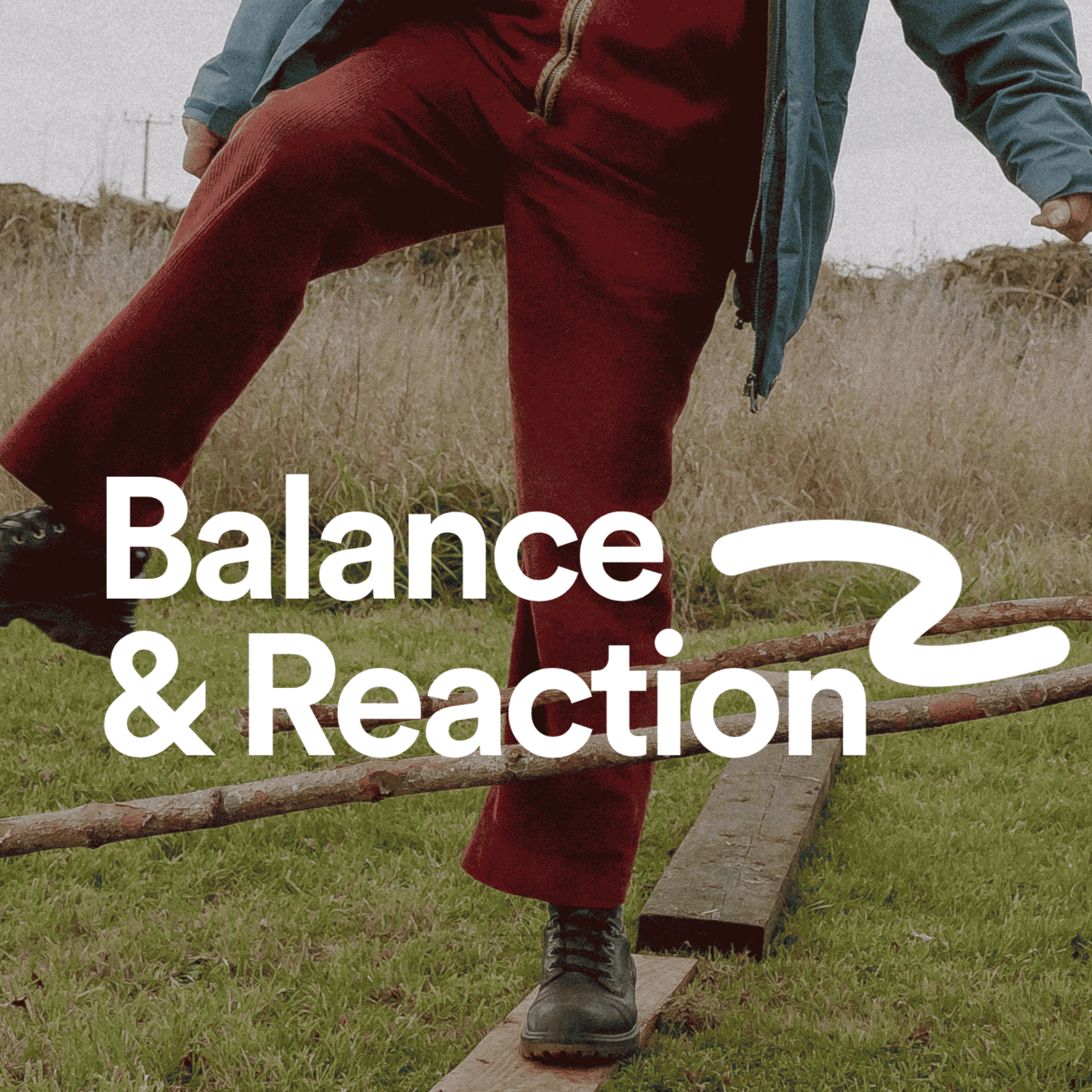
What does balance look like in real life?
Practical ideas
Balance exercises to try
Balance training can be more useful when it includes movement, reaction and changing positions — not just standing still. Here are six simple ways to start exploring it.
Tandem walking
Walk slowly with one foot placed directly in front of the other, as though you are walking along a narrow line.
This challenges your balance while moving rather than standing still.
Single-leg reach
Stand on one leg and gently reach one foot or hand in different directions.
The goal is not to stay perfectly still, but to practise controlling small changes in your position.
Step and recover
Step forwards, backwards or sideways and practise regaining your balance after each step.
Gradually vary the direction, speed and size of the step.
Uneven-ground walking
Grass, woodland paths and other slightly uneven surfaces can introduce more variation than a flat indoor floor.
Start somewhere manageable and build confidence gradually.
Get down to the floor and back up
Practising different ways of lowering yourself to the floor and standing back up develops strength, mobility, coordination and confidence together.
There is no single “correct” way to do it.
Reaction games
Ask someone to point in a direction, roll an object towards you or give you an unexpected movement cue.
The aim is to react and adapt rather than rehearse exactly the same movement each time.
Move through more
Mobility exercises to try
Mobility is about being able to actively use the ranges of movement available to you. These exercises combine movement, control and coordination rather than simply trying to stretch further.
Hip movement
Explore comfortable squats, step positions and hip rotations to practise moving your hips through different ranges.
Start with the range you have and gradually explore more as it feels comfortable.
Ankle mobility
Gently move forwards over the ankle while keeping your foot grounded and notice how the ankle responds.
Ankle movement can support walking, stepping, squatting and moving over uneven ground.
Rotation
Practise turning through your torso in a comfortable range from standing, sitting or kneeling.
Rotation is something we use constantly in everyday movement.
Crawling
Crawling combines movement through the shoulders, hips and trunk while also challenging strength and coordination.
It can be adapted in lots of different ways depending on your starting point.
Rolling
Practise rolling between different positions on the floor and explore how you use your whole body to change direction.
This can help build confidence with moving at ground level.
Floor transitions
Move between sitting, kneeling, lying and standing in different ways rather than always using the same route.
These transitions combine mobility, strength and coordination together.
Understanding the difference
Mobility vs flexibility
Flexibility is generally about how far a joint or muscle can move.
Mobility is broader. It is about how well you can actively use that range of movement.
For example, being able to move your hip through a large range while someone stretches your leg is different from being able to control that range while stepping, squatting or getting up from the floor.
WildStrong tends to focus on movement you can actually use.
Flexibility
Flexibility describes the range of movement available at a joint or through a muscle.
It tells you how far you can move, but not necessarily how well you can control that movement.
Mobility
Mobility is your ability to actively move through and control useful ranges of motion.
It is about creating movement you can actually use in everyday life.
Make it more playful
Turn balance into play
Balance training doesn’t have to look like a traditional balance class. Simple games and movement tasks can help you practise balance, coordination and reaction in a way that feels more like real life.
Try things like balancing a broomstick while walking, moving through an obstacle route, throwing and catching from different positions, reacting to a partner’s cue or carrying something while changing direction.
The aim is not to perform each task perfectly. It is to give your body opportunities to respond, adjust and solve movement problems.

Balance & Reaction
£37. Available now!
A short course focused on building dynamic balance and reactivity through playful movement.

5 Days of Playful Movement
£27. Available now!
A five day short course introducing playful movement and helping you to find movement opportunities all around you.
Want More Structured Support?

In Person Courses
Whether you’re a coach-in-training or just looking to move better, our in-person courses help you build strength, confidence, and real-world movement skills.

Online Courses
Train anywhere, anytime with our expert-led movement courses, designed to help you build strength, mobility, and confidence at your own pace.

Training for Community Groups
Play coaching that helps adults build strength, balance, and confidence outdoors while connecting with others.

A note before you start
Balance and mobility exercises should be adapted to your current ability, confidence and experience.
If you feel particularly unsteady, have experienced recent falls or injuries, or have a health condition that affects your movement, it can be helpful to speak with an appropriate healthcare professional before starting a new exercise programme.
Start somewhere that feels manageable and build the challenge gradually. You do not need to force range, move quickly or make an exercise harder before you feel ready.
WildStrong resources are designed to support learning and confidence around movement but are not a substitute for individual medical advice.
Frequently Asked Questions
-
Useful balance exercises include tandem walking, single-leg reaches, stepping in different directions, walking over uneven surfaces and practising how to recover when your balance changes. The most useful approach usually combines static, dynamic and reactive balance rather than relying on one exercise alone.
-
Balance can be practised little and often. Short, regular sessions can work well, especially when the exercises are varied and gradually become more challenging. You can also build balance into walks, strength sessions and everyday movement.
-
Yes. Balance is a skill that can be trained throughout life. Strength, coordination, reaction time, confidence and regular exposure to different movement challenges can all influence how well you balance.
-
Useful mobility exercises include squatting, reaching, rotating, crawling, rolling, stepping and moving between the floor and standing. The aim is to actively use and control useful ranges of movement rather than simply stretch further.
-
Flexibility is generally about the range of movement available at a joint or muscle. Mobility is about how well you can actively control and use that range in real movement.
-
You do not need to start on the floor. You can begin from a chair, higher surface or supported position and gradually work lower as your confidence and ability improve. Getting down and back up is a skill that can be broken into smaller steps.
-
Balance training can be part of a wider approach to improving fall resilience, alongside strength, coordination, reaction and confidence. It can be useful to practise not only staying balanced, but also responding and recovering when your balance changes.