
A self-guided course to get comfortable, curious and confident on the ground.
Being comfortable and confident on the ground opens up all sorts of possibilities in everyday life, whether you're gardening, playing with your kids, enjoying a picnic, or simply exploring different ways to move.
In this two-part course, we'll explore how to spend time on the ground, finding comfortable positions and moving between them, and how to travel along it, through crawling, scrambling and finding different ways to get from A to B.
There's no perfect way to do the activities: the aim is to find what feels manageable for you now, and gradually add challenge over time.
Two parts, two weeks
Part 1: Spending time on the ground (Ground Transitions). Explore different positions on the ground and ways to move between them. You'll find comfortable resting positions, shift between them and adapt how you move to suit everyday tasks, whether that's reaching for something, moving out of someone's way, or passing around food at a picnic.
Part 2: Moving along the ground (Ground Locomotion). After one week, you'll also get access to Ground Locomotion. Here you'll discover different ways to travel and navigate your surroundings while staying close to the ground: crawling, scrambling, getting under things, working around obstacles and even heading down a steep slope.
There's no need to master one before moving on to the other. The idea is to introduce new movement challenges gradually, giving you time to experiment and build confidence as you go.
Is this right for you?
This course assumes you're already comfortable getting down to and back up from the ground independently. We cover that in a separate Movements for Life module. If you find those movements difficult, we'd recommend building your confidence with them first, as these activities may not be suitable for you just yet.
Building your movement goggles
Ground Confidence brings together two modules from our wider Movements for Life course and helps you build capability at your own pace.
Rather than teaching you a “perfect” way to move, the aim is to help you solve movement problems, discover what works for you and expand your sense of what's possible.
This course isn't an all-encompassing programme. It's here to give you ideas, build your confidence and help you start noticing chances to spend time on, and move along, the ground in everyday life.
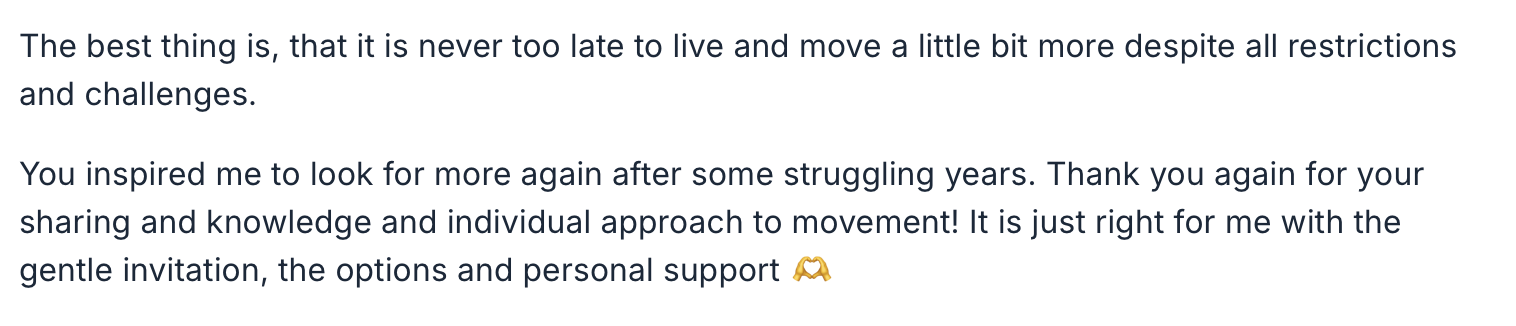
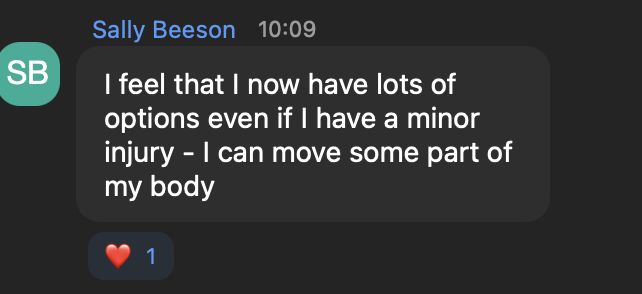
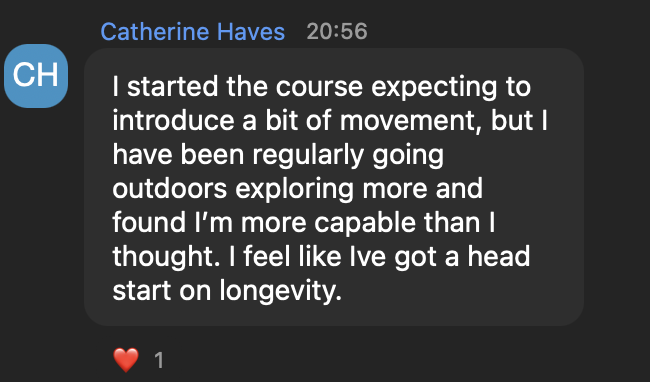
“There’s so much thought behind every movement. It’s not just ‘do this exercise,’ it’s why it matters, how to adapt it, what to notice. I felt like I was learning a new language with my body.”
Carol, 53


What you'll learn
Comfortable resting positions: sitting, squatting, lying down, kneeling and on hands and knees
Different ways to move between positions
Support strength, stability and transitional strength
Practical mobility for reaching, passing and interacting with the world around you
Crawling, scrambling and other ways to travel along the ground
Coordination, as different parts of your body learn to work together
Navigating obstacles and uneven terrain with more confidence
How challenge builds
Each activity lets you find a starting point that feels manageable, then gives you the tools to gradually add challenge over time.
Choosing your warm-up: follow a set plan, or imagine a situation and move your way through it
Choosing your workout in Ground Transitions: Quality & Control, or Strength & Conditioning
Choosing the activity that suits your wrists in Ground Locomotion: Crawling Floor is Lava, or Attic Explorers, which keeps you low with less pressure on your wrists
Adding challenge with the 5 S's: space, stability, skill, speed and strength
Building a human agility course of small challenge stations
Using movement snacks and a printable Movement Log to bring it into everyday life
What you'll need
Simple things you likely already have
Comfortable ground, such as carpet, a warm wooden floor or a lawn
A few small objects, such as rolled-up socks, shoes, sticks or stuffed animals
A towel or a piece of fabric
Cardboard strips, boxes or string, and other everyday items you can safely move over, under or around
Optional: a heavy bag or kettlebell, and card and tape to make a printable movement die
Module 2: Ground Confidence
✔ Two self-guided weeks: Ground Transitions, then Ground Locomotion, which unlocks after one week
✔ Two warm-up styles each week: a set plan or a situational one
✔ Full activity library with follow-along videos, a printable movement die and online position and locomotion generators
✔ Quality & Control and Strength & Conditioning workouts in Ground Transitions, and a human agility course in Ground Locomotion
✔ A printable Movement Log to track your progress
✔ Movement snacks for days when you're short on time
✔ Hosted inside our Circle community: follow along on your phone, tablet or desktop, wherever suits you.
£67 inc. VAT
(approx. $89 USD)
Hosted on Circle — follow along on your phone, tablet or desktop, wherever suits you.
“When you’re wobbling, you’re learning. Catching yourself and finding your way back to equilibrium is not a sign you’re doing something wrong — it’s exactly what we’re looking for.”